
|
James Dickson Innes 1887-1914
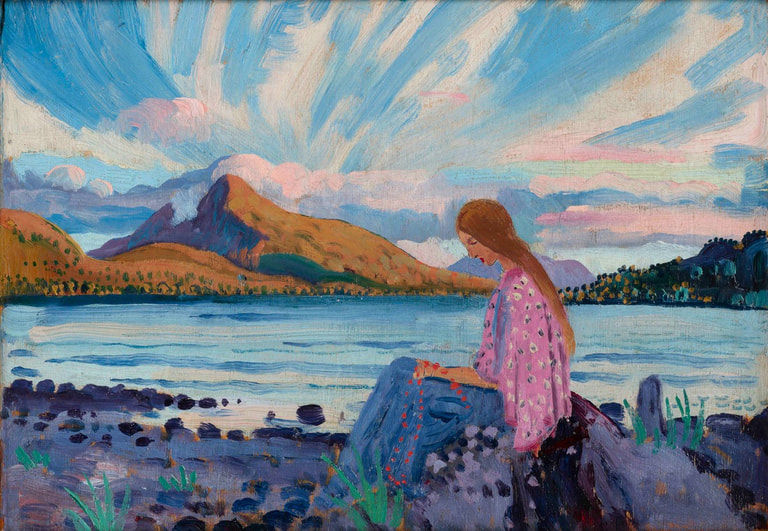
By the Lake, Bala c.1911-12 Oil on panel 9 x 13 inches (22.9 x 33 cm) PROVENANCE Horace de Vere Cole (1881-1936); George Montagu, 9th Earl of Sandwich (1874-1962); his sale, Christie's, London, 30 November 1962; Christie's, London, 13 November 1964; Thomas Agnew & Sons; Mr & Mrs John Stanley-Clarke; their sale, Sotheby's, London, 14 March 1973; The Fine Art Society; Private Collection. EXHIBITED Twentieth Century Art, Whitechapel Art Gallery, London, 1914 (460); J.D. Innes, The Chenil Gallery, London, April-June 1923 (?27); Paintings by J.D. Innes, Leicester Galleries, London, May 1928 (109); Augustus John, J.D. Innes, Derwent Lees, Paintings 1910-14, The Redfern Gallery, London, February-March1939 (47); Camden Town Recalled, The Fine Art Society, London, 1976 (79); James Dickson Innes, Southampton Art Gallery, September-October1977, National Museum of Wales, Cardiff, November-December 1977, The Fine Art Society, London, December 1977-January 1978, Manchester City Art Gallery, March-April 1978 (81). LITERATURE John Fothergill, J.D. Innes, London 1946, pp.7, 68, repr. pl.50; Apollo, March 1970, repr. pl.176; John Hoole & Margaret Simons, James Dickson Innes 1887-1914: Catalogue Raisonné, London 2013, cat. no.244, repr. col. pl.122. |
|
James Dickson Innes occupies a unique place in early twentieth-century British painting. In a career tragically cut short by illness at the age of just twenty-seven, he produced a small but extraordinary body of work distinguished by its luminous colour, emotional intensity and poetic response to landscape.
A decisive influence on Innes’ development came through his exposure to modern French painting. During visits to Paris he encountered the colour and expressive freedom of artists associated with the Mediterranean town of Collioure, where painters such as Henri Matisse and André Derain had pioneered the bold palette of Fauvism. Their liberation of colour from strict naturalism had a profound effect on the young artist, encouraging him to approach landscape not as a topographical record but as an arena for sensation, light and emotion. These modernist influences found a powerful counterpart in the wild landscape of Snowdonia in North Wales, where Innes spent periods painting with his close friend Augustus John. The mountains and lakes of the region provided an environment in which artistic experimentation and personal experience seemed inseparable. Snowdonia became, for Innes, both a creative refuge and a stage for some of his most inspired works. By the Lake, Bala captures this moment of heightened creative energy. Painted on the shores of Llyn Tegid, the largest natural lake in Wales, the work depicts the warmth of sunset spreading across the still water and surrounding hills. The landscape is rendered with a fluid, expressive handling of paint that allows colour and atmosphere to dominate the composition, conveying a sense of immediacy and vitality. The female figure is Euphemia Lamb, Innes' mistress and companion. Her presence transforms the landscape into something more than a record of place. Rather than standing apart from the scene, she appears almost absorbed into the glowing surroundings, reinforcing the sense of unity between human presence, nature and the artist's emotional world. |